
Título da Obra: OS EMIGRANTES
Autor: W. G. SEBALD
Tradução: JOSÉ MARCOS MARIANI DE MACEDO
Fictional literature accommodates a wide variety of languages. Good authors avoid the gratuitous or sensational use of unconventional forms of writing. When they do employ them, the manner of saying something serves the efficiency, force, and beauty of what is said. Winfried Georg Sebald, or W. G. Sebald (1944–2001), is exemplary in his consistent use of alternative modes of expression. His literary output is not vast, but it is brilliant. Born in Germany, he lived and worked for most of his life in England, where he eventually died. Though raised in the Catholic tradition, his background did nothing to diminish his sensitivity to—and solidarity with—the Jewish tragedy that unfolded in his native country during the Second World War, which ended only a year after his birth.
Sebald reflects on the individual’s disorientation before the hollowing-out of meaning in his own actions, especially when those actions are ostensibly well justified. He focuses on the human being moving within society, building his history out of the events in which he takes part. He examines the workings of affective memory when it is used to smooth the edges of biography, rendering life more palatable. Yet he shows that it is not always possible to make disappear, with any efficiency, what is troubling or painful to remember.
Throughout several of his books he includes photographic images that are not always easy to interpret at first glance. These images may carry as much polysemy as the written text. The Emigrants is a novel that draws upon both reality and fiction to recount the wandering of human beings as they construct their destinies—a tragic misalignment between belief, idealization, and the expectations brought to bear upon the life one actually lives.
Four characters serve as narrative axes, each of them rich in the truth they embody fictionally. At first, the reader may imagine they will be treated as subjects of historical-biographical account. Yet as the narrative unfolds, they merge into a shared mission: to speak of exile as a fate—inescapable and, in a certain sense, universal.
The themes Sebald addresses are legitimate within the broadest contexts. One of his stylistic resources is his refusal to structure stories in a linear fashion, for in the manner he presents them, they subvert the artifices commonly used to make the psychological and moral weight of events tolerable—just as may occur with men and women who penetrate more deeply into the labyrinth of their own histories.
In addition to The Emigrants, other works of his have been translated into Portuguese: Vertigo, Austerlitz, The Rings of Saturn, and several others. All are excellent.
Title of the Work: The Emigrants
Author: W. G. Sebald
Translator: José Marcos Mariani de Macedo
Editora: COMPANHIA DAS LETRAS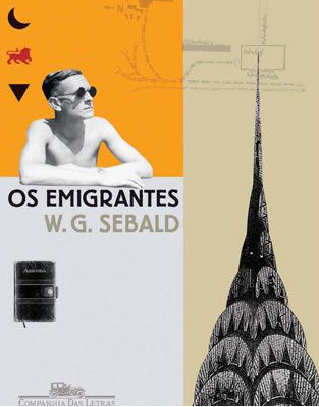

 Estante do Justo
Uma dica e tanto, estava procurando um bom livro que tratasse de emigração.
CurtirCurtido por 1 pessoa
Obrigado por comentar
CurtirCurtir