
For many reasons, Philip Roth stands among the greatest writers of the world. A writer of remarkable talent, he possesses the rare gift of captivating the reader through stories that are not only well told, but deeply resonant. And beyond that, he displays a lucidity and clarity of mind that allow him to understand, describe, and explore fundamental human problems with depth and sophistication. There is nothing banal in his work.
From the beginning of his career, Roth was a fine writer; but with Patrimony, he became a genius. And he was prolific. He died on May 22, 2018, at the age of eighty-five, leaving behind a monumental legacy. I believe he will endure, inhabiting the worlds of his readers — including those yet to come. Almost everything he wrote is exceptionally good. Employing a language of relatively simple structure, he handles delicate themes with remarkable complexity. He provokes thought. He invites intelligence into the interpretation of life. He enriched the intellectual and moral heritage of our time.
Faithful to his Jewish and American origins, Roth transcended geography to become what he was. A powerful current runs through the whole of his work: the tragic dimension of reality’s refusal to submit to human will — no matter how noble the purpose, no matter how great the effort.
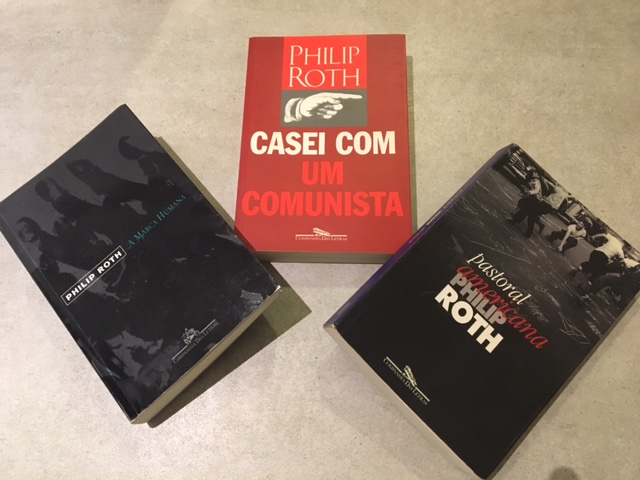
In constructing his novels, he often turns ethics inside out, employing contortions and reversals to deconstruct and question behavioral norms that appear well established. Morality is always under scrutiny. In American Pastoral, I Married a Communist, and The Human Stain, he narrates situations so vivid they attain a stature close to the reader’s own lived experience. It all feels true — a ceaseless struggle between good and evil, an immense effort to discern one from the other.
The plots of these three novels are distinct, yet the trilogy is justified by the thematic core that binds them. In The Human Stain, Roth deals most directly with the hypocrisy that can accompany “politically correct” behavior, and with the cruelty people are capable of in the name of supposed virtue. I Married a Communist portrays a marriage that devolves into painful drama and tragic disillusionment, born of the deceptions that emerge from the superficiality of relationships that appear intimate but are far from it. American Pastoral reveals the indomitable forces that can destroy a life’s project — particularly when human relationships form its very foundation.
Roth exposes the difficulty, if not impossibility, of overcoming egoism, pettiness, narrowness of perception, utopian delusion, and the impulse toward destruction — those undesirable yet intrinsic human qualities. They are, for the most part, involuntary elements, broadly reflected in social phenomena, shaping our attempts (or failures) to act benignly in common life. His novels recount the odyssey of humankind in its struggle to become better than it is, or perhaps better than it can be.
Reading Roth is always a delight, despite the density of his thought — an opportunity to draw close to a mind that is intelligent, courageous, and aesthetic in the truest sense of the word. Transformative.

 Estante do Justo
Viva Philip Roth!
CurtirCurtir
Viva!
CurtirCurtir
Meu amigo, adoro seu conhecimento e a facilidade em nos trazer de modo tão claro e simplificado leituras que são preciosas. 💋
CurtirCurtir
Obrigado querida Teresa
Bjs
CurtirCurtir
Muito bom.
CurtirCurtido por 1 pessoa
Muito bom! Compartilho minha admiração pela literatura de Philip Roth.
CurtirCurtido por 1 pessoa
Obrigado por comentar
CurtirCurtir