
Editora: PLANETA: CRÍTICA
One day, King Frederick William IV of Prussia declared that Alexander von Humboldt (Berlin, 1769–1859) was “the most formidable of all men since the Flood.” Certainly, before and after him, there have been other exceptional individuals who, like Humboldt, transformed the way the world is understood. Yet the king’s words were well deserved. Gifted with a prodigious capacity for observation and a creative mastery of information—combined with a deep love of Nature and an unwavering ethical sense—Humboldt generated an astonishing body of knowledge. And he changed the course of Science itself.
Fearless—or perhaps reckless—in his pursuit of knowledge, Humboldt left behind the comfort of his native Prussia, where he enjoyed social privilege and wealth, to embark on the intellectual adventure of discovering the world firsthand, of witnessing its phenomena with his own eyes. He traveled tirelessly. He was a contemporary—and a brilliant interpreter—of the great events that marked the late eighteenth and early nineteenth centuries: the French Revolution, the rise and fall of Napoleon, the wars of independence led by Bolívar, and the birth of modern democratic republics, among others. A universe in transformation.
It was in Latin America that Humboldt made his most significant discoveries. He climbed the Chimborazo volcano (in present-day Ecuador), observing the variations of flora and fauna with changes in altitude; he journeyed through the interior of Venezuela, and upon visiting Lake Valencia, he deduced that human action upon Nature could bring about unpredictable and devastating harm. He noted how deforestation for agriculture had turned fertile land into desert. Comparing natural life across diverse regions of the globe, he perceived that latitude and altitude were fundamental determinants.
He thus conceived the earliest notions of ecology and of the interconnectedness of natural phenomena throughout the planet. A libertarian at heart, he encouraged the independence of colonized nations (particularly those under Spanish rule). He abhorred slavery and declared so openly whenever the occasion arose. He was scandalized by humankind’s relentless impulse to dominate its own kind.
Humboldt lived as he wished, both publicly and privately, yet always within the bounds imposed by his ethical conscience. He was a friend and an inspiration to the great figures of science—though the very concept of “scientist” would emerge only after he began his work—as well as to thinkers in literature, art, politics, and philosophy. Goethe, Thomas Jefferson, Darwin, Gay-Lussac, Schiller, Walt Whitman, Jules Verne, and Ezra Pound all drew profound inspiration from him in their respective fields. He may well have been the most widely read author of his time.
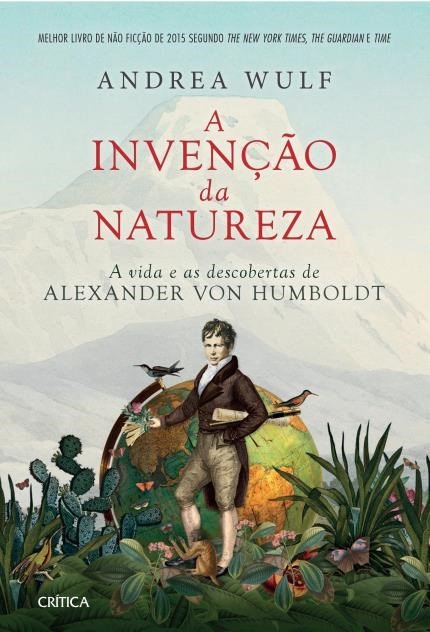
Yet this is only part of what the historian and writer Andrea Wulf, born in India in 1967 though of German descent, recounts in her book The Invention of Nature: The Adventures of Alexander von Humboldt, the Lost Hero of Science. Written with remarkable fluency and vitality, Wulf’s work offers readers both a wealth of information and a refined intellectual delight. Considered one of the finest works of non-fiction in recent years, it provides a deeply pleasurable reading experience while restoring to the present the legacy of this extraordinary scientist and humanist. It is, in truth, a rare opportunity to feel a genuine pride in our species.
Title: The Invention of Nature: The Adventures of Alexander von Humboldt, the Lost Hero of Science
Author: Andrea Wulf
Translator (Portuguese edition): Renato Marques
Publisher: Planeta: Crítica

 Estante do Justo
Abc
CurtirCurtir
Prazer em conhecer!!!
Mantenha-me informado!!!
Valeu!!!
CurtirCurtido por 1 pessoa