
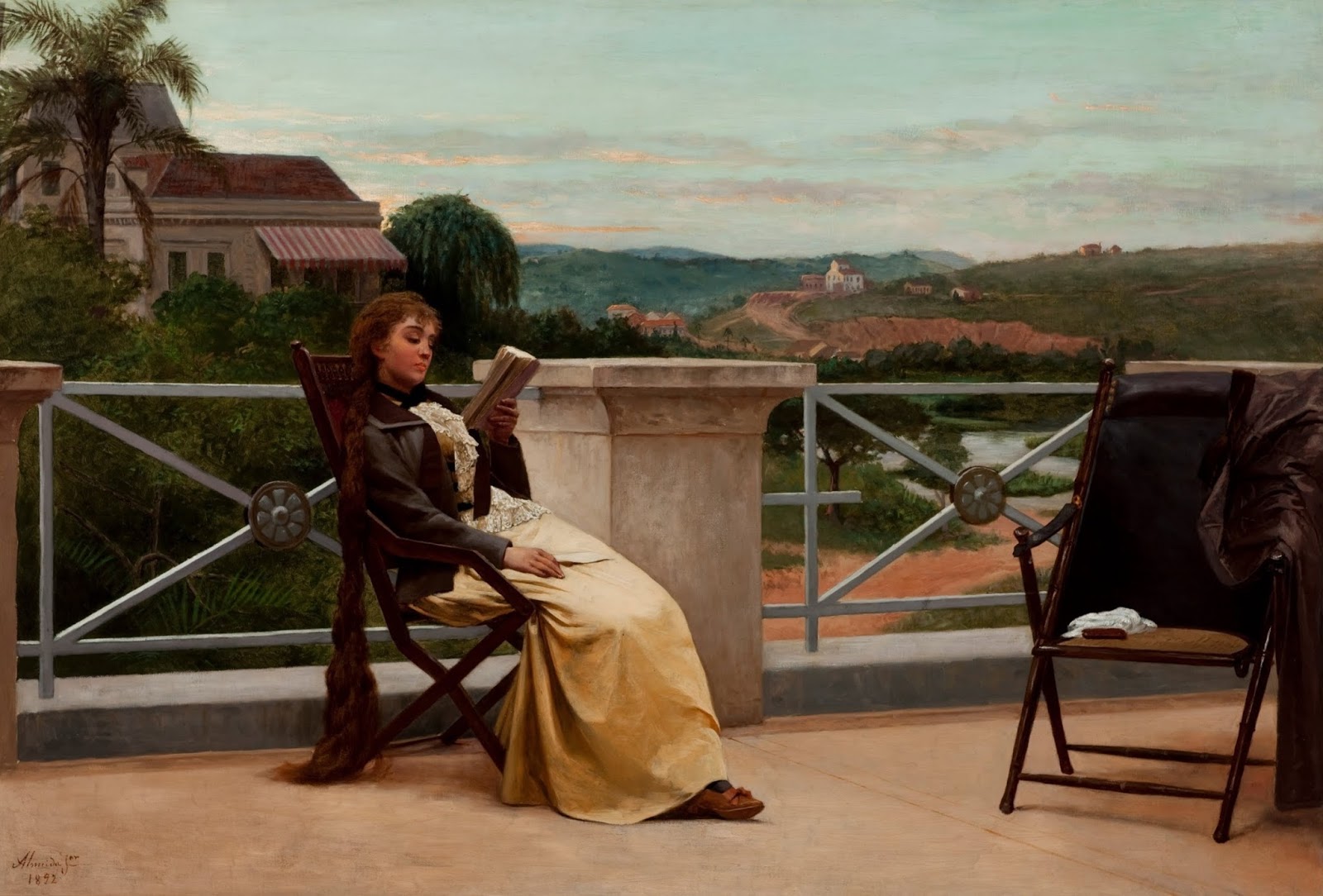
Abaixo, obra do pintor brasileiro Almeida Júnior: “Leitura” de 1892, óleo sobre tela, 95X141 cm, Pinacoteca do Estado de São Paulo
READING AND FREEDOM
Since words are invariably polysemous, it is worth outlining the approximate sense of freedom as it is used here. It is, first of all, a noun—an abstract one, rightly so—far more useful to indicate an aspiration, a goal, or an ideal than to denote a concrete reality. Freedom can never be fully captured or experienced in absolute form, even though it remains a vital compass for human life. One must also acknowledge that we are never free from the conditions imposed by Nature. We are biological creatures before we are social ones, largely governed by natural “imperatives,” which set boundaries on what we may hope for under the banner of freedom. Moreover, the forces that drive our psychological life are complex, elusive, and far less “tameable” than we might expect. To this we must add the challenges inherent in social interaction: in the ways individuals relate to one another and societies function. Good and evil interlace here, and freedom may be violated with disconcerting ease. It may thus be stressed that Freedom is, above all, an idea—even as it deeply shapes objective reality. Often enough it may be transfigured into lived experience. It is precious in sustaining what is most human in us, lest we become mere automatons or puppets. Freedom is always something to be won.
The ability to read is also a conquest. It begins with literacy and matures through the ever-expanding capacity to interpret texts—in all their forms—with richness of meaning and possibility. Reading fuels and is fueled by the creation of new ideas, by the widening of conceptual horizons beyond rote learning and the passive absorption of group beliefs. It can nourish and fortify. It may provide the grounding for us to take positions and make decisions in life.
At the same time, reading good texts may work a kind of “magic” that softens the hardness of daily life, which is often turbulent, difficult, and at times paralyzing. Reading grants us creative “holidays” from the world’s tempests. It colors existence. It restores vitality. Through reading we journey into other lives, other stories, other ways of seeing. A systematic and varied practice of reading—extending beyond academic or professional demands—nurtures autonomy of thought, refines critical capacity, and deepens both emotional and intellectual maturity.
Reading may thus serve as an instrument in the pursuit of ever-greater degrees of freedom. It enables us to secure what is indispensable within this vast concept. It aids us in the work of understanding and managing our limits and limitations, while also helping us to explore our creative and benevolent potential. A possible Good.
We may even suppose a kinship between the aptitude for good reading and the experience of freedom itself.
(Below: Leitura, Almeida Júnior, 1892, oil on canvas, 95 × 141 cm, Pinacoteca do Estado de São Paulo.)

 Estante do Justo
Belo texto, Luis. Sintético, mas completo. Um resumo da extrema complexidade do que é ser livre sem o livro. Gostei muito
CurtirCurtir
Olá Anderson,
Muito obrigado por seu comentário
CurtirCurtir
Muito obrigado pelo comentário Anderson.
CurtirCurtir
Perfeita! Reflexão
CurtirCurtir
Obrigado
CurtirCurtir
Um belo texto, muito bem escrito e
Inspirador.
CurtirCurtido por 1 pessoa
Obrigado
CurtirCurtir
Adorei o seu texto! Ele sintetiza minha luta de uma vida inteira pelos livros, leitura, literatura e, portanto, esta liberdade de que vc falou. Parabéns .
CurtirCurtido por 1 pessoa
Obrigado Emília
CurtirCurtir