
Muitas são as fantasias daqueles que permanecem encerrados numa vida mais convencional sobre os que, por inquietação ou por necessidade, aventuram-se pelo mundo. Estes podem experimentar o que é diverso daquilo que moldou sua formação, renunciando ao conforto de futuros que sempre estiveram presentes, para o bem e para o mal.
O conto “Uma Pequena Nuvem” de James Joyce fala de dois homens que conviveram na juventude e depois de oito anos distantes reencontram-se em Dublin, cidade natal de ambos. O que ficou vivendo na capital da Irlanda, Thomas ou Little Chandler, tinha uma vida estável, com um emprego armado em previsibilidades, casado e com um filho pequeno, numa relação precocemente rançosa com a mulher. Seu antigo companheiro, Gallaher, vivia em Londres, trabalhando na imprensa e tinha viajado por outros lugares.
A vida de Little Chandler é mais permeável ao leitor enquanto a de Gallaher é desenhada por suposições e pela descrição de sua atitude no pouco tempo em que conversam no balcão de bar de um restaurante sofisticado da cidade. Importa o contraste entre os que ficam e os que partem, entre os que vão em busca do novo e os que se acomodam ao que conhecem, entre os que ambicionam com timidez e os que avançam sobre possibilidades remotas. Talvez haja uma alusão ao conformismo, à submissão à colonização e à tentativa de independência, o que se aplica tanto para as dimensões mais privadas e íntimas como para questões de âmbito público e político, lembrando da posição dos irlandeses frente aos ingleses na época em que o texto foi escrito. Dublin versus Londres.
Certamente este conto, assim como os outros que compõem “Dublinenses”, presta-se a muitas interpretações que transcendem ao mencionado neste comentário. É um dos mais saborosos e carregados de sugestões do célebre livro.
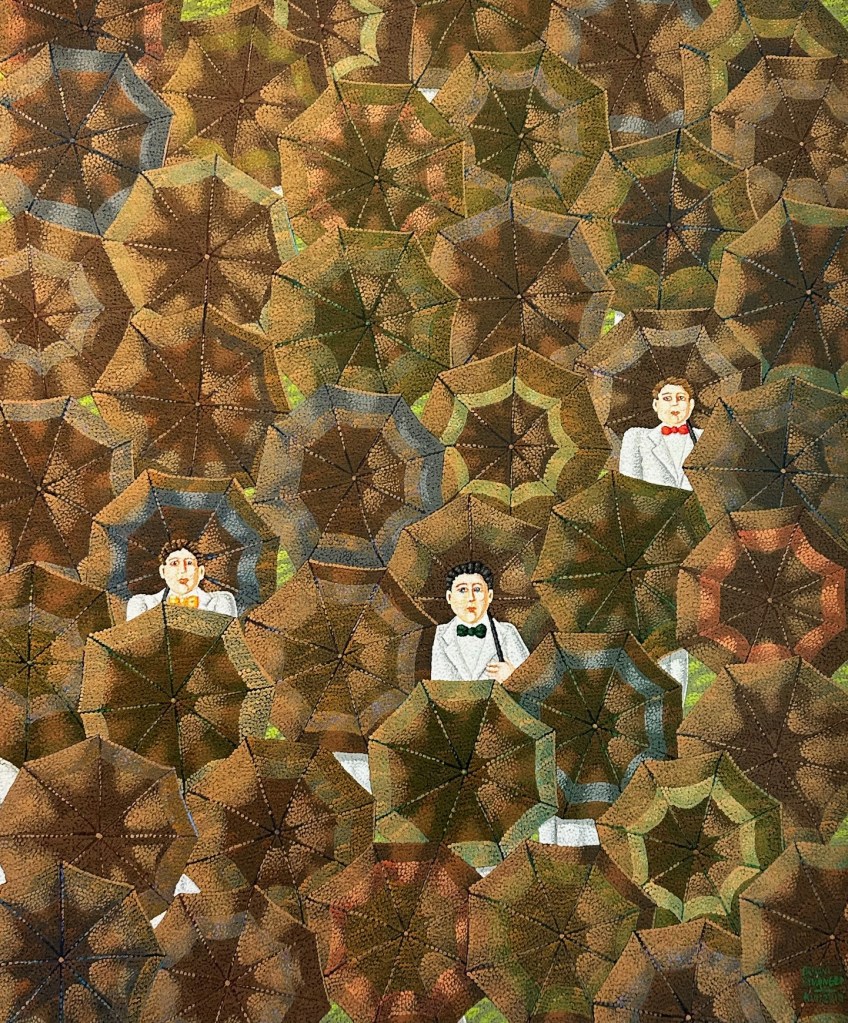
Na ilustração: foto de pintura de Ernani Pavaneli (São João Nepomuceno, MG, 1942 – Rio de Janeiro, 2018)
Título da Obra: UMA PEQUENA NUVEM (em “DUBLINENSES”)
Autor: JAMES JOYCE
Tradutor: CAETANO W. GALINDO
Editora: PENGUIN/COMPANHIA DAS LETRAS
A Little Cloud
Many are the fantasies nurtured by those who remain confined within conventional lives about others who, driven by restlessness or necessity, set out into the world. Such wanderers may experience what lies beyond the familiar boundaries that shaped them, renouncing the comfort of predictable futures—for better or worse.
James Joyce’s short story A Little Cloud portrays two men who had been close in their youth and, after eight years apart, meet again in Dublin, their native city. The one who stayed behind, Thomas—known as Little Chandler—leads a settled, circumscribed life: a secure but stifling clerical job, a respectable home, a marriage already tinged with resentment, and a small child. His old companion, Gallaher, has been living in London, working in journalism and traveling widely.
The reader gains fuller access to Little Chandler’s inner world, while Gallaher’s life remains sketchy—outlined through hints, boasts, and the brief conversation they share over drinks in a fashionable Dublin bar. What emerges is a poignant contrast: between those who stay and those who depart, those who timidly dream and those who seize remote possibilities, those who adapt to their given world and those who break away from it. Implicit, too, is an allegory of conformity and rebellion—of submission to colonization and the yearning for independence—reflections of the Irish position under English rule at the time Joyce wrote the story. Dublin and London, in this sense, stand as emblems of stasis and expansion, restraint and freedom.
Like the other tales in Dubliners, this story lends itself to many interpretations that reach far beyond what is briefly suggested here. It is one of the most finely wrought and evocative pieces in Joyce’s celebrated collection—at once delicate, ironic, and profoundly human.
Illustration: photograph of a painting by Ernani Pavaneli (São João Nepomuceno, MG, 1942 – Rio de Janeiro, 2018)
Title: A Little Cloud (from Dubliners)
Author: James Joyce
Translator: Caetano W. Galindo
Publisher: Penguin / Companhia das Letras

 Estante do Justo