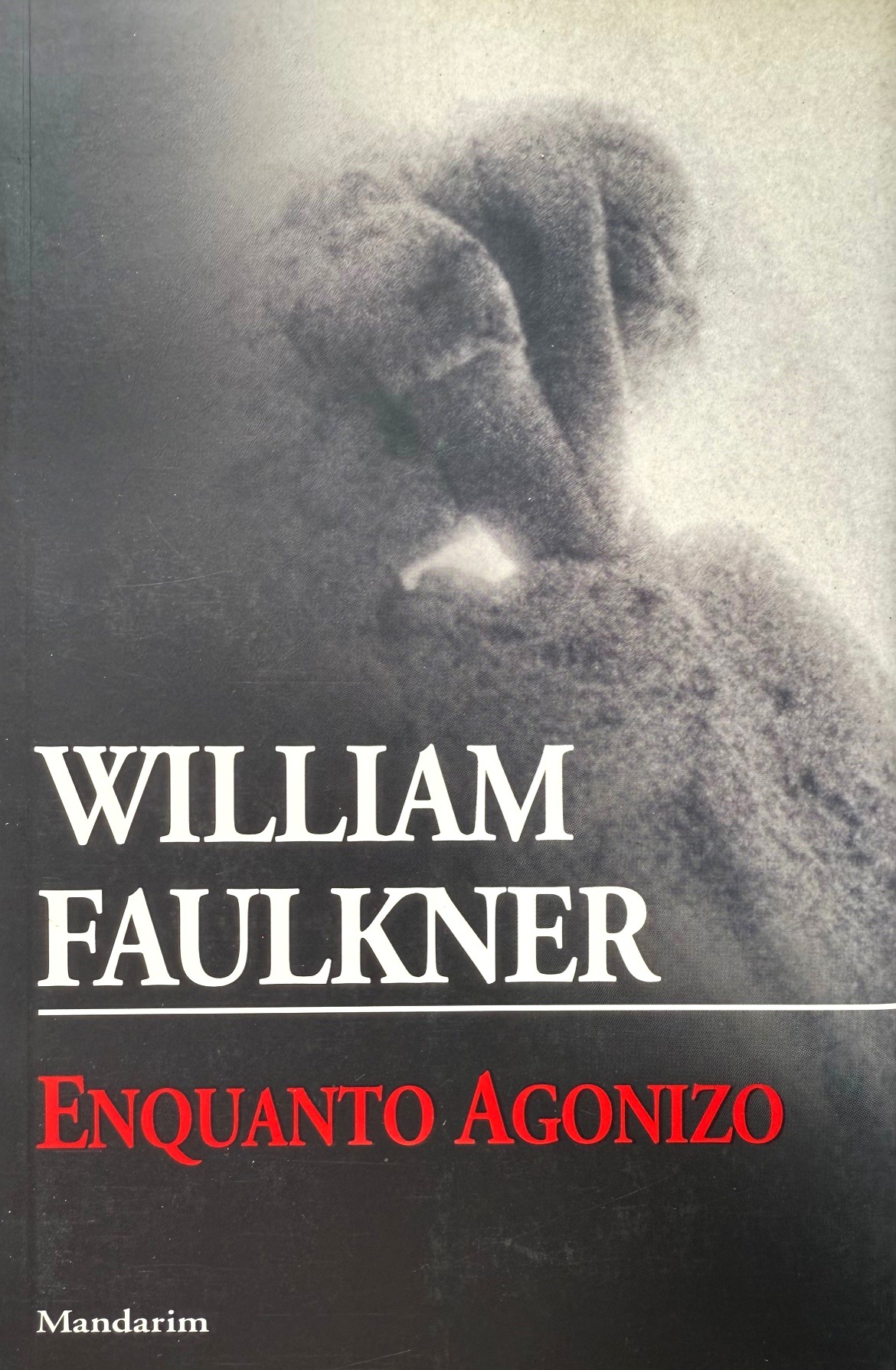
William Faulkner (EUA, 1897-1962) nasceu e morreu no Mississippi, estado do sul dos Estados Unidos da América. Viajou pelo País e por diversos outros. Conviveu com intelectuais e, oriundo da classe abastada, transitou entre seus membros, leu os mais instigantes autores da literatura universal. Manteve-se fortemente vinculado à região onde nasceu e identificado com os que mais sofreram com as mudanças e com as não-mudanças. Não se tornou um acadêmico. Viveu num período relativamente próximo da Guerra de Secessão (1861-1865), travada entre estados do sul e do norte por questões como o separatismo e a escravização da população negra. Testemunhou metamorfoses sociais, que incluíram “a grande depressão econômica” do final dos 1920 e início de 1930 com consequências avassaladoras. Toda a sua obra é povoada por personagens que refletem vivamente seu meio, escultor de grande parte do que cada um era. “ENQUANTO AGONIZO”, um de seus romances famosos concentra muito do entendimento que Faulkner tinha do mundo.
Como em outros de seus livros, a linguagem não é direta, linear ou transparente. O que diz parece ter que ser extraído dos rios de água barrenta do Mississippi ou de sob a terra grudada nos corpos em árduos dias de trabalho. William Faulkner é um dos autores que empregou fartamente o “fluxo de consciência” como estilo narrativo, método pregnante no Movimento Modernista Literário no Ocidente.
Cada capítulo tem o nome de um personagem, o que não corresponde exclusivamente a seu ponto de vista sobre o que se passa, mas entra na soma elementos interrelacionados, auxiliando num tipo de comunhão entre os quinze indivíduos presentes. O título do livro é bastante significativo e guarda algumas possibilidades de interpretação. Em princípio parece dizer respeito aos momentos finais de uma mulher, Addie Bundren, acamada por alguma doença e cujo caixão está sendo construído por um de seus filhos. Todavia, sua morte se dá no terço inicial do romance, quando sua agonia teria cessado. Curiosamente a narrativa ganha ainda mais força após seu falecimento. O marido, Anse, está determinado a enterrá-la em Jefferson, cidade de onde ela veio, supostamente cumprindo o desejo da esposa. Ele e os cinco filhos do casal enfrentam um duríssimo percurso para chegar ao local do sepultamento. Neste trajeto o enredo torna-se mais potente e dá espaço aos personagens. Além de suas singularidades, as condições de vida que tanto determinam seus destinos ficam mais visíveis. Addie, pensando durante um momento em que ainda estava viva e longe de seu fim, aponta para o que parece ser o mais significativo na teia narrada e cujo título sumariza ao citar seu pai dizendo “que a razão para viver era se preparar para estar morto durante muito tempo”, uma espécie de período de agonia compreendido entre o nascimento e a morte. Agoniza-se enquanto se vive.
Ainda que exista muito em comum entre os diferentes protagonistas, que se manifestam numa polifonia perdida em algo irredutível ao que as palavras podem descrever, as peculiaridades de cada um importam. Quase tudo se desenha em sugestões ou indícios sobre suas vidas para além dos acontecimentos relatados na trajetória fúnebre. Os filhos da falecida, Darl, Cash, Jewel, Dewey Dell e Vardaman, seu marido e outros personagens são muito distintos e compõem um mosaico, construindo uma imagem do humano naquele contexto. Vale destacar as menções à sexualidade, mais relacionadas a Jewel e Dewey Dell, pouco claras, mas bastante impactantes, especialmente quanto ao primeiro. O texto cria uma espécie de agonia na tentativa de transitar pela realidade, de reconhecer o que é verdadeiro e o que mais tem valor. O caminhar para atravessar a vida resvala com frequência no insano, nas motivações difíceis de explicar pela razão. Há titubeios entre o que é determinado pelas circunstâncias, pela tradição e pela religião e o que provém da natureza. Qualquer coisa poderia se tornar absurda se não houvesse pressa em se afirmar que não o era.
Como outros autores da época (por exemplo, James Joyce ou Virgínia Woolf, entre outros), Faulkner rompeu com um modo de escrever e deu um lugar diferente ao que se poderia denominar enredo numa obra literária. Acabou por ressaltar aspectos menos óbvios, dizíveis e palatáveis nas histórias das pessoas.
Título da Obra: ENQUANTO AGONIZO
Autor: WILLIAM FAULKNER
Tradutor: WLADIR DUPONT
Editora: MANDARIM
William Faulkner (United States, 1897–1962) was born and died in Mississippi, a state in the American South. Though he travelled throughout his country and abroad, and mingled with intellectuals—moving naturally within the affluent class from which he came and reading the most provocative authors of world literature—he remained profoundly tied to the region of his birth, identifying himself with those who suffered most from change and from the lack of it. He never became an academic.
He lived in a period relatively close to the American Civil War (1861–1865), fought between the Southern and Northern states over issues such as secession and the enslavement of Black people. He witnessed social metamorphoses, among them the Great Depression of the late 1920s and early 1930s, with its devastating consequences. His entire body of work is inhabited by characters who vividly reflect their milieu—sculptors and sculptures of one another’s fates. As I Lay Dying, one of his most celebrated novels, concentrates much of Faulkner’s vision of the world.
As in many of his books, the language is neither direct, linear, nor transparent. What he says seems to need to be dredged from the muddy rivers of the Mississippi, or unearthed from the clay clinging to the bodies of those who labor through hard days. Faulkner was among the first to make abundant use of the stream of consciousness technique, a hallmark of the Western literary modernist movement.
Each chapter bears the name of a character, though this does not mean it expresses solely that character’s point of view. Rather, it brings together interwoven elements, creating a kind of communion among the fifteen narrators. The title of the novel is deeply significant, holding several layers of interpretation. At first, it appears to refer to the final moments of a woman—Addie Bundren—bedridden with illness, her coffin being built by one of her sons. Yet her death occurs within the first third of the novel, when her agony should, in theory, have ceased. Curiously, the narrative gains even greater force after her death.
Her husband, Anse, is determined to bury her in Jefferson, the town from which she came, supposedly in fulfillment of her dying wish. He and the couple’s five children endure a harsh journey to reach the burial place. Along this journey, the plot expands in power and gives greater prominence to the characters. Beyond their singularities, the harsh conditions that shape their destinies become more visible. While still alive, Addie reflects at one point on what seems to be the novel’s most essential thread—encapsulated in its title—when she recalls her father’s saying that “the reason for living is to get ready to stay dead for a long time,” suggesting that life itself is a prolonged form of agony between birth and death. One agonizes while one lives.
Though the protagonists share much in common—voices mingling in a polyphony irreducible to what words can fully convey—their particularities matter greatly. Much is drawn in suggestion, in hints about their lives beyond the funeral journey. The deceased’s children—Darl, Cash, Jewel, Dewey Dell, and Vardaman—her husband, and the others together form a mosaic, constructing an image of humanity within that world. Noteworthy are the allusions to sexuality—particularly concerning Jewel and Dewey Dell—which remain obscure yet carry deep emotional weight, especially in Jewel’s case.
The text creates its own kind of agony in its attempt to move through reality, to discern what is true and what holds value. The passage through life often borders on madness, driven by motivations difficult to explain through reason. There is a constant wavering between what is dictated by circumstance, tradition, and religion, and what springs from nature. Anything could seem absurd—were it not for the haste with which people deny its absurdity.
Like other modernist writers of his time—James Joyce, Virginia Woolf, among others—Faulkner broke with conventional narrative form and redefined the notion of “plot” in literature. He brought to light the less obvious, less speakable, and less palatable dimensions of human experience.
Title: As I Lay Dying
Author: William Faulkner
Translator: Wladir Dupont
Publisher: Mandarim

 Estante do Justo