
Entre o muito que se pode extrair dos contos de “Dublinenses” de James Joyce (Irlanda, 1882 – Suíça, 1941) há uma série de retratos de pessoas comuns na vida da cidade durante o tempo em que o autor viveu lá.
“Dois Galantes” é uma janela para entrever algumas cenas da Dublin que estava em Joyce. Nela transitam dois personagens, Corley e Lenehan. Aspectos de seu caráter transparecem nas ações e diálogos durante as horas em que circulam pelo anoitecer boêmio da cidade. Já não são mais tão jovens, talvez pudessem ter conquistado uma posição ou condições de vida que lhes permitissem mais conforto e satisfação consigo mesmos. Vagueiam e embrenham-se em anseios marcados pelo que se poderia chamar de “pobreza de espírito”. É algo diferente do flanar a esmo. Eles percorrem o tempo pelo espaço no qual podem enxergar o universo em que habitam. Talvez este modo de construir narrativas possa ser considerado bastante característico do estilo de Joyce. Traduz um entendimento sobre o que observou.
Corley, como ator, e Lenehan, seu expectador, complementam-se. Falam sobre moças pobres com quem estabelecem relações passageiras para pequenos programas de diversão. Daí estabelece-se a ação. Está em jogo um tipo de manipulação que visa explorar as mulheres. Algumas trabalham na prostituição outras não. Parece que os dois homens estão tecendo seus vãos destinos ou sendo passivamente coniventes com a pequenez que lhes foi destinada. Seu entorno é demasiadamente estreito. Não exubera a maldade, mas sim um comportamento patético, dissoluto. O papel que eles atribuem às mulheres indicam parte significativa do que eles são, ao menos no momento em os que vemos.
Como nos outros contos do livro, o que é informado e interpretado pelo escritor está envolto num tipo de sutileza que faz parecer haver pouco no que é dito. Falsa impressão. Talvez um modo de James Joyce desafiar seu leitor, fazer com que ele seja obrigado a usar lentes de amplificação para ver o que o autor pretende mostrar.
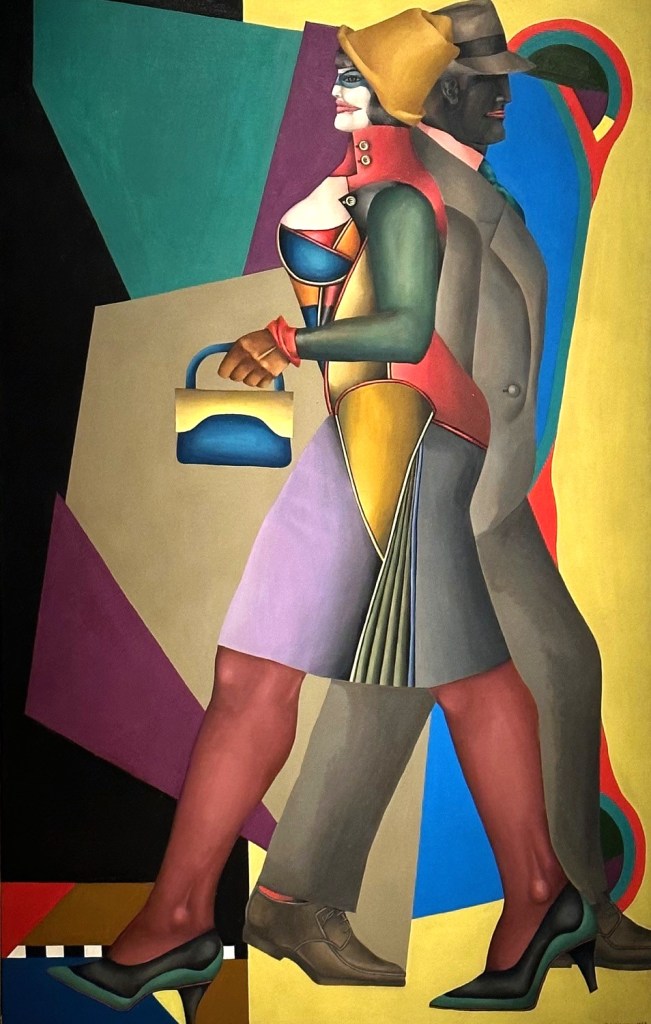
Na ilustração: foto de obra de Richard Lindner (Hamburgo, 1901 – Nova York, 1978)
Título da Obra: DOIS GALANTES (parte de “DUBLINENSES”)
Autor: JAMES JOYCE
Tradutor: CAETANO W. GALINDO
Editora: PENGUIN/COMPANHIA DAS LETRAS
Two Gallants
Among the many insights that can be drawn from Dubliners by James Joyce (Ireland, 1882 – Switzerland, 1941), one finds a gallery of portraits depicting ordinary people in the everyday life of the city during the time the author lived there.
Two Gallants opens a window onto that Dublin which inhabited Joyce’s imagination. Through it move two characters—Corley and Lenehan—whose temperaments and dispositions are revealed in their actions and exchanges as they wander through the city’s nocturnal streets. They are no longer quite young; one senses that they might have once aspired to better positions or more comfortable circumstances, but now drift through a life tinged with disappointment. Their restlessness is not the leisurely flânerie of the idle stroller; rather, it is a weary circling within the narrow confines of their own world. This narrative mode—observation rendered through movement and mood—might be seen as quintessentially Joycean, translating perception into quiet revelation.
Corley, the actor of schemes, and Lenehan, his spectator and companion, complete each other. They talk of poor girls with whom they strike up transient affairs for small pleasures. The story’s action unfolds from such encounters, which soon reveal a kind of moral opportunism—exploiting the women’s naivety or poverty. Some of these women are prostitutes, others not; in either case, Corley and Lenehan seem trapped in the pettiness of their own design, at once architects and victims of their diminished lives. There is little malice in them—only a melancholy vulgarity, a dissolution born of mediocrity. The way they speak of women reflects who they are, or at least who they have become in the narrow light of this evening’s adventure.
As in Joyce’s other stories, what is told and what is left unsaid form an intricate weave of understatement. The apparent simplicity of his prose conceals depths of observation and irony. Joyce demands that the reader look closer—that they adjust the lens of attention until the faintly drawn lines reveal the complex humanity beneath.
Illustration: Photograph of a work by Richard Lindner (Hamburg, 1901 – New York, 1978)
Title of the Work: Two Gallants (from Dubliners)
Author: James Joyce
Translator: Caetano W. Galindo
Publisher: Penguin / Companhia das Letras

 Estante do Justo